Years: 2024 - Ongoing
Media: Mixed media, Projection, Multi-channel Audio, Video loop
Collaborators: Ella Joy Meyer (audio & composition), Torin Blankensmith (real-time graphics)
Exhibited: RIP Space, Los Angeles, California, September 2024
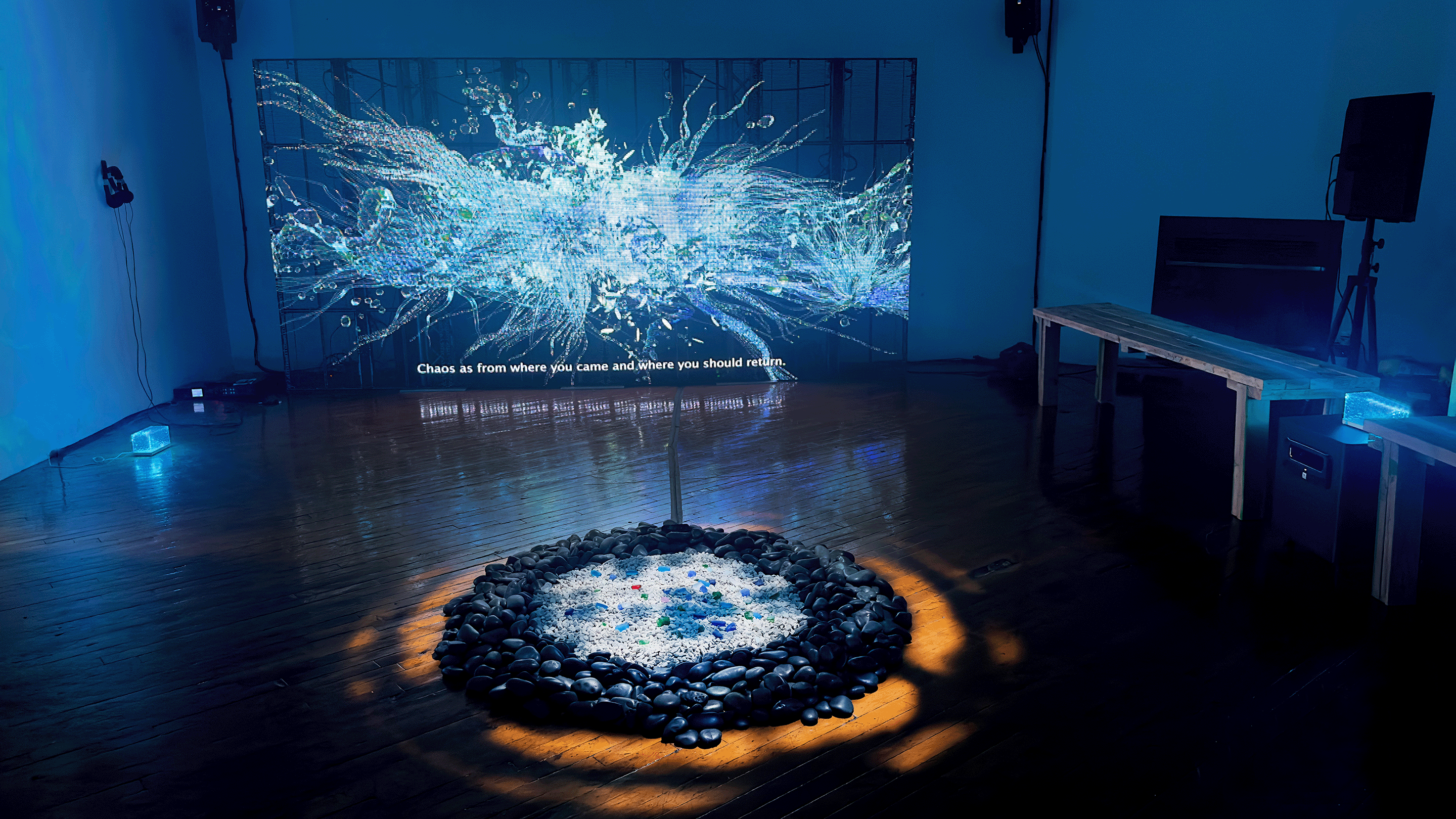
Photo description: Displayed alongside visual art by Qianqian Ye, Tiare Ribeaux, Isabel Beavers, and John Threat
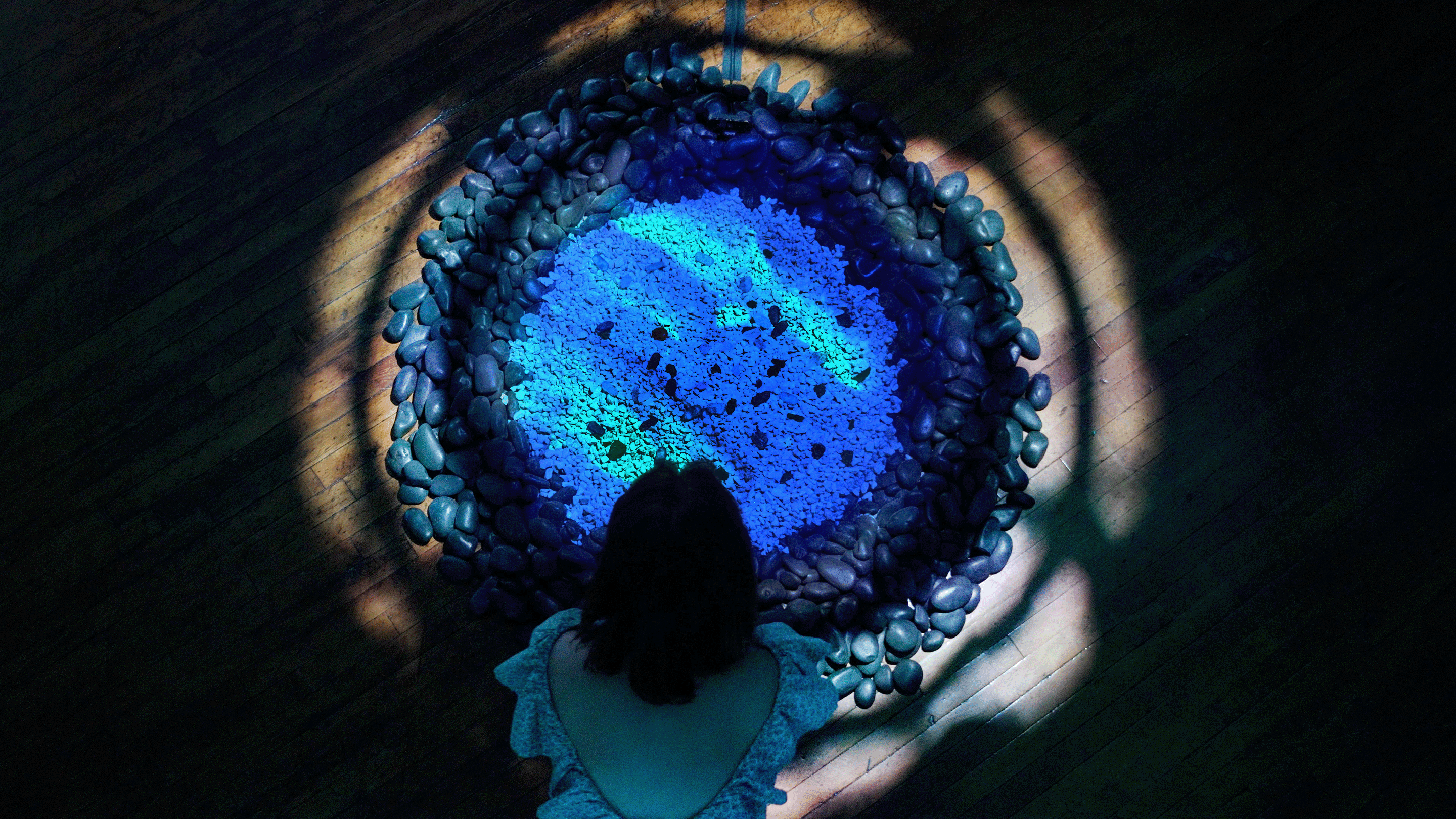
Song of the Sea is an immersive audio-visual installation exploring fragile connection, interspecies collaboration, and co-creation across human and more-than-human worlds. The work asks a simple but expansive question: what does water hold, what stories does it carry, and how does it connect us all? Conceived as an ongoing research-based project, the installation unfolds as an “indoor ocean,” inviting deep listening, reflection, and embodied attunement to aquatic life.
The project draws inspiration from research by Project CETI and broader scientific and philosophical inquiries into language, intelligence, and culture in other-than-human species. It engages the ocean not as backdrop, but as an active, communicative presence that challenges human-centric ideas of meaning, creativity, authorship, and agency.
At the core of the piece is a multi-channel soundscape composed from field recordings collected during a 2023 research expedition to Dominica, where I spent a week at sea following a local pod of sperm whales. Dominica, a Caribbean country that is home to a year-round population of sperm whales and a comparatively healthy reef ecosystem, has emerged as a key site for cetacean research. During this time, I recorded underwater audio and video of pod interactions, documented reef ecologies, and spoke with researchers and local families whose lives are deeply intertwined with the whales. I was lucky to witnessed intergenerational relationships between humans and whales, meet children who were raised alongside the pod and pod’s calfs and spoke to their parents who have a tender friendship with the matriarch of the pod. All of that revealed a reality of coexistence rather than separation.
Sound is the primary material of Song of the Sea, shaping the visual, spatial, and emotional experience. Designed as a deep-listening environment, the soundscape invites a state of receptivity, empathy, and reflection rather than spectacle. Drawing on the rhythms of breath and heartbeat as much as oceanic movement, it is airy, expansive, and harmonically rich and cinematic. It encourages a sense of awe and stillness, while allowing space for the listener’s own thoughts and memories to surface.
The composition emphasizes low, resonant drone frequencies that can be felt physically, echoing the pressure and density of deep water. High-frequency tones are used sparingly to avoid fatigue over long durations. Sound is spatialized throughout the space, with certain elements audible only from specific angles or in proximity to particular objects, creating a shifting, embodied listening experience.
The soundscape unfolds in three movements - Descent, Exploration, and Ascent - mirroring the physiological and psychological experience of entering, inhabiting, and emerging from the ocean:
Descent introduces heavy drones that evoke the tactile sensations of submersion: pressure compressing air pockets, labored breathing, and the tension between survival and curiosity as the body adjusts to the new environment.
Exploration emerges as the senses adjust. The drone recedes, revealing a rich chorus of whale song, reef noise, and subtle human vocalizations engaged in call-and-response. Curiosity, play, and serenity take hold as participants become fully immersed and attuned.
Ascent marks a gradual return. Pressure lightens, drones dissolve, and the score becomes brighter and more spacious with sunlight piercing the water’s surface, followed by a full, grounding breath.
Additional sourced recordings include humpback whales, blue whales, pilot whales, and various reef fish, woven together into a layered acoustic ecology.
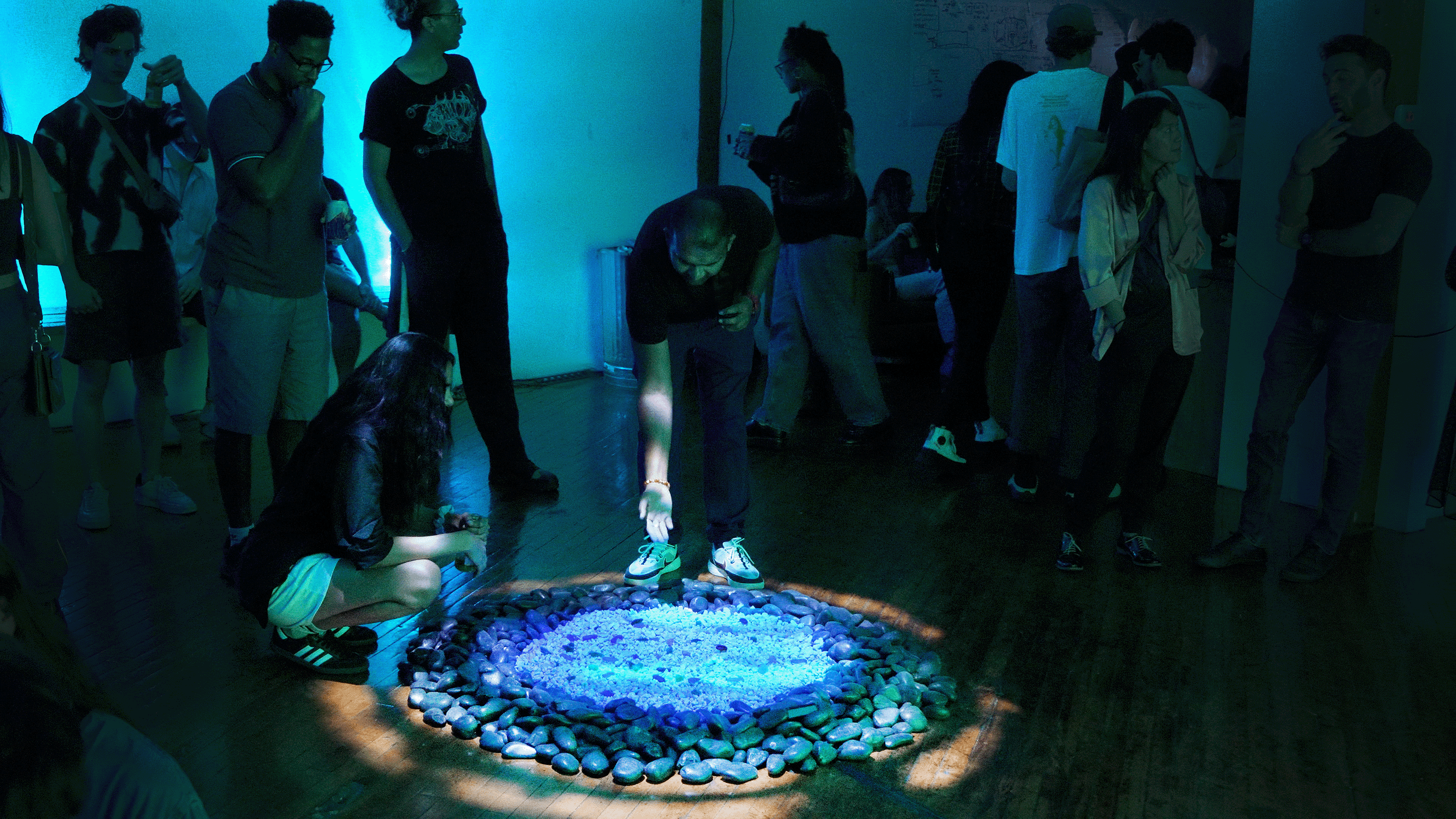
For the exhibition, the installation included a sculptural “digital tide pool” built from locally sourced rocks.
Visitors were invited to participate by placing a piece of collected sea glass into the pool. The gesture functioned as a quiet ritual of reconciliation, co-creation an offering back to the sea.
Participants were prompted to reflect on the journey of the glass: once a vessel of value, then broken and discarded as trash, but softened over time by tides, eventually returning to its elemental form of silica.
Each contribution became part of a growing collective landscape, symbolizing the slow, cumulative work of healing our relationship with the natural world, where small acts of care ripple outward into larger systems of change.
If you's like a longer preview of the piece, head out to Vimeo
